Showing posts with label vehicle. Show all posts

Saturday, August 21, 2010

ecocar car : Electric Car Uses Bumps to Charge Battery

This strange looking car is an interesting concept designers, industrial Kim Jung Hoon was a record year for the 2010 Michelin Challenge Design competition. Unlike other electric cars, which is connected in particular in relation to the charging station or an extension cord, Eco-P has four piezoelectric devices to recharge the battery when the car is moving.


Kim thought the P-Eco, that the car is a lot of energy that can be collected and converted to lose. Whenever the vehicle is in motion, and vibration is reflective and could be used piezoelectric device to generate power that can recharge the battery. Piezo on both sides of each seat, this concept car can not be operated effectively without additional costs for electricity or gasoline.


Car, of course, the need for other energy sources, such as backup, especially if it is not used for some time. But it would be fairly easy to draw, and the batteries to charge only in the home network, and then keep moving car while on the road. Concept is based on the future effectiveness of the piezoelectric based, it makes sense, I know, but now will one day produce uneven road, it was really good.

Sunday, March 14, 2010

Concept Car : Solid Futuristic Car

The Solid vehicle does have the standard protection means, like safety-belts and airbags. It also has two special elements installed in front and in the back of the car. These elements provide additional maneuverability by turning around. They also are very strong in if a cras hoccurs as they take the damage on itself and thus saving the booth.For further information


Friday, March 12, 2010

Concept Car : BMW Vision EfficientDynamics 2010

For decades, BMW has made the reduction of emissions and fuel consumption a key part of its product development strategy, just as enhancements to the dynamic ability of each BMW have been a lasting, sustained brand value. BMW’s EfficientDynamics engineering philosophy – the pursuit of an enhanced, athletic driving experience while simultaneously lowering the consumption and emissions of each vehicle – resulted in the most dramatic drop in fleet consumption of any automaker from 1990 through 2005, according to an Environmental Defense study.


Now, the BMW Vision concept car clearly demonstrates that the EfficientDynamics objectives are fully compatible when applied to a sports car. Conceived as a 2+2-seater with plug-in full-hybrid technology, this unique car combines the performance of a BMW M vehicle with a standard of fuel efficiency and emission management that exceeds even the current levels achieved by the latest small cars. This outstanding result is made possible by the combination of BMW ActiveHybrid components with an extremely economical combustion engine, and outstanding aerodynamic qualities.


BMW Vision EfficientDynamics is the result of a “clean-sheet” development process to ensure that the correct achievements were made in the areas of efficiency, driving pleasure, technology, and emotional design. BMW Vision EfficientDynamics is the most comprehensive implementation of the EfficientDynamics philosophy seen so far. The powertrain provides a top speed limited electronically to 155 mph, with acceleration to 100 km/h in 4.8 seconds. Average fuel consumption in the EU test cycle is 3.76 liters/100 kilometers, equal to 62.6 mpg, and the CO2 emission rating is 99 grams per kilometer. CO2 emission management is even more outstanding when driving in the all-electric mode after charging the battery from a plug-in source: Taking all emissions in the generation of electricity into account, as prescribed by the EU formula, the car’s emission rating is just 50 grams per kilometer.


Through this unique balance of driving pleasure and fuel efficiency, the BMW Vision EfficientDynamics concept car clearly demonstrates the potential of BMW ActiveHybrid technology, which makes its world debut at the 2009 Frankfurt Motor Show in the BMW ActiveHybrid X6 and BMW ActiveHybrid 7 production models.


The power and performance are made possible by combining a fuel-efficient 3-cylinder turbodiesel with one electric motor on each axle. The intelligent combination of these units, together with precisely controlled energy management, simultaneously enhances the dynamic performance and the efficiency of the car. Overall system output is 356 horsepower, and peak torque is 590 lb-ft. The special arrangement of the two motors and diesel engine allows all-wheel drive when driving in all-electric mode. The result is minimum power loss and a harmonious transmission of the power available under all conditions.


In its design, BMW Vision EfficientDynamics for the first time conveys the dynamic look of a BMW sports car to a hybrid vehicle. Developed with decades of experience in Motorsport, the body of this unique sports car is a result of intelligent lightweight technology and aerodynamic efficiency. In the design of the interior, the focus was likewise on both the fascinating driving experience and, in particular, on transparent, hands-on technology and maximum reduction of weight.


Turbodiesel engine with unprecedented specific output


The combustion engine is a cutting-edge turbodiesel featured for the first time in the BMW Vision EfficientDynamics concept car. Displacing 1.5 liters on three cylinders, the engine consistently follows the downsizing principle of using a relatively small engine combined with a turbocharger to reduce fuel consumption.


Through its compact dimensions, the 3-cylinder fits conveniently in front of the rear axle like in an agile mid-engine sports car, despite the two seats at the rear. Fuel is injected by the latest generation of High Precision Direct Injection, and the turbocharger features variable intake geometry for maximum efficiency. Engine output is 163 hp with peak torque of 214 lb-ft.


The specific output of 109 hp per liter sets a new benchmark in diesel technology. The power delivered by the turbodiesel is conveyed to the rear axle by means of a double-clutch transmission (DCT). This advanced transmission technology, which already offers a particularly dynamic driving experience in BMW’s M3 and Z4 Roadster, allows the driver to shift gears without the slightest interruption of power. BMW Vision EfficientDynamics features a newly-developed version of BMW’s DCT with six speeds for maximum efficiency and flexibility.


Two electric motors for full-hybrid drive

The combustion engine is supplemented by two electric motors. Consistently applying the BMW ActiveHybrid philosophy, development engineers followed the principle of “Best of Hybrid,” choosing the optimum combination of a hybrid synchronous motor on the front axle and a full-hybrid system at the rear.


In this concept, the driver benefits from the efficiency of the electric motors over a far wider speed range than with a conventional hybrid car. The rear axle comes with a second-generation full-hybrid system corresponding to the technology in the BMW ActiveHybrid 7 production model. The compact electric motor positioned between the diesel engine and the DCT outputs a consistent 33 horsepower and is able to reach a peak of up to 51 hp. Maximum torque for the rear electric motor is 214 lb-ft, the power, either supporting the diesel engine or in all-electric motoring. When coasting or applying the brakes, the electric motor acts as a generator and feeds electric power to the lithium-polymer battery in the car. The electric energy developed in this way is therefore captured without any additional consumption of fuel through the principle of Brake Energy Regeneration. Energy wasted on the brakes of a conventional car is thus saved within the new power system for subsequent use in driving the car.


A second electric motor acts on the front axle. This engine, a hybrid synchronous motor, offers continuous output of 80 horsepower and peak torque of 162 lb-ft. Extra power of 112 horsepower is available for a period of up to 30 seconds, and, for a 10-second “burst,” the electric motor is able to develop 139 horsepower. The power is transmitted through a 2-stage, single-speed reduction gearbox.


BMW Vision EfficientDynamics is able to run completely under electric power, with the power of the turbodiesel engine alone, or through an infinite combination of the three power sources. Depending on driving conditions, the two electric motors may be used both for accelerating and for regenerating energy when applying the brakes and while coasting. This principle ensures efficient energy management, with the charge status of the lithium-polymer battery constantly remaining within the optimum range. When accelerating, the electric motors help to boost the car for even greater performance, ensuring immediate response and a significant reduction in fuel consumption. For a short time, such as in passing maneuvers, the cumulative maximum output of all three engines increases to 356 hp, with maximum torque generated by the three engines reaching 590 lb-ft.

—-


Lithium-polymer battery for electrical energy


The energy cells featured in BMW Vision EfficientDynamics are housed in a chassis element running from front to rear through the middle of the car. The front unit is the lithium-polymer complex, an ongoing development of the lithium-ion battery. Overall, BMW Vision EfficientDynamics comes with a total of 98 lithium-polymer cells, each offering a capacity of 30 amp/hours and developing continuous output of 600 Amps at a voltage of 3.7 V. For a period of 30 seconds, each cell is even able to develop maximum output of 1,200 Amps.


Serial arrangement of the lithium-polymer cells serves to generate nominal voltage of 364 volts, the gross storage capacity of the battery is 10.8 kW/h. With an unusually high discharge capacity of 80 percent, the battery delivers 8.6 kW/h for driving the car. This superior performance comes on overall weight of the entire energy storage system of just 187 lb. A further advantage is that through their optimum dimensions tailored to the specific qualities and features of the car, the lithium-polymer cells, together with the operating strategy chosen with a concept of “forward looking” energy management, reduces the thermal load acting on the battery to such an extent that there is no need for active cooling.


Plug-in solution: convenient charging of the electric power system from a conventional power socket.


Brake Energy Regeneration captures electric power generated while driving without additional fuel consumption, which is subsequently used to supply power to the electric motors and on-board network. A further option is to connect the lithium-polymer cells to a conventional power socket for a simple and efficient charge process, using a plug-in connector in the front-right wing of the car. Connected to a standard EU power outlet (220 V, 16 Amps), the system requires a maximum of 2 ½ hours to fully charge the lithium-polymer cells. And wherever a power source with higher voltage and amperage (380 V, 32 Amps) is available, the charge time is an even shorter 44 minutes.

Wednesday, March 10, 2010

Concept car : Opel Flextreme GT/E 2010


The German automaker Opel will unveil a new electric concept car this March at the 2010 Geneva Motor Show. According to the company’s first details, the Flextreme GT/E concept which will preview much of the company’s future thinking ideas in terms of design and engineering. Using green innovation and alternative propulsion, the concept is proof that size and comfort do not need to be sacrificed for a vehicle to be environmentally efficient.


Full story

Concept car : Jeep Hurricane


Jeep Hurricane Concept Car powerful powertrain performance is an understatement considering the Jeep Hurricane. There are two 5.7- litre HEMI engines in the vehicle, one in the front and one in the back. Both engines deliver 335 horsepower and 500 N.m (370 lb-ft) of torque a total of 670 hp and 1000 N.m (740 lb-ft) of torque.


Fullstory

Monday, March 8, 2010

Concept car : Daihatsu Lineup 2009


DAIHATSU MOTOR CO., LTD. (Daihatsu) plans to exhibit six concept cars of four different vehicle series and nine production vehicles along with new technologies at the 41st Tokyo Motor Show to be held from October 24 to November 4 at the International Convention Complex (Makuhari Messe) in Makuhari, Chiba Prefecture.


Full Story

Sunday, March 7, 2010

Concept car : Ford Synergy 2010


The silver car is the Ford Synergy 2010, a 1996 concept car projecting a family car of the future (2010) that could get 80 miles per gallon. It was funded in part by the Clinton-era industry cooperative venture "Partnership for a New Generation Vehicle" program. The Synergy was designed as a light-weight but midsized vehicle (approximately 2,200 lbs.) with a 1-liter direct-injected diesel engine with electric assist.

Saturday, February 27, 2010

Concept car : Volvo S60 2010


Wednesday, May 13, 2009

Concept Car


The following two exclusive images show Lovegrove's latest passion and ultimate dream -- to design a car. His inspiration for this concept was to create a vehicle that contributes to a cleaner, more joyful world.


It would contain few parts, be athletic but not aggressive, lean, efficient, and transparent in order to allow drivers to look out at the world going by.

Concept Car : MAZDA KAAN E1 RACE CAR

Unlike some of the other entrants in this year’s LA competition, Mazda hasn’t forgotten to pen its concept with childlike awe; the Kaan features a sweeping, aerodynamic shape constructed with plenty of carbon. The centre-less wheels look strangely like beer bottle openers from the side - though not many bottle openers have light beams running across their centres.


Also unique among all the entrants is the idea that Kaans don’t compete alone, but rather in a peloton - a close knit pack of cars in formation like cyclists in a race. According to Mazda, the closer the pack sticks together, the more aerodynamic and thus faster it becomes. A lightning bolt inspired all that, allegedly.
Early Retirement or Podium Finish: Finishes just outside the top three when one of the peloton gets too close and clips another during the final lap, causing a multiple comedy tankslapper among the entire pack.


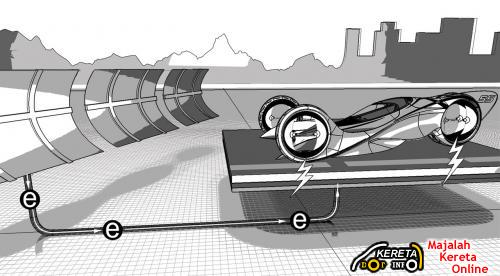
The MAZDA KAAN is an electric race car designed to compete in the E1 races, the pinnacle of international motorsports in terms of technology and popularity. In 2025, California freeways have been resurfaced with a sub-level electro-conductive polymer that powers the electric cars of the modern world. MAZDA’s patented electronic tire system uses this technology to power the KAAN to reach 250 mph with no harmful emissions!

The vehicles are piloted by individual drivers but teams are made up of thirty cars, all on the track together. Using strategies similar to those in cycling peletons, the tighter the group sticks together, the more aerodynamic and powerful it becomes.


Inspiration for the KAAN comes from electric fields and textures seen in nature, particularly those in a lightning bolt. The car is uniquely designed around its powerful electric wheels while the cockpit acts as a capsule to safely house the driver, allowing for tighter peloton formations and a team victory.

Saturday, May 9, 2009

Concept Car : Peugeot RD Model Revealed in Shanghai


The Peugeot RD concept design of 27 year old Carlos Arturo Torres Tovar is now on exhibition as a full-size model at the 2009 Auto Shanghai in China. The Colombian has just graduated from the National University of Colombia where he studied Industrial Design.
His concept car was the winning project in Peugeot's 5th Annual Design Competition which saw prospects from 95 different nationalities submit over 2,500 projects. The theme for the contest was "Imagine the Peugeot of the Worldwide Megalopolis of tomorrow" which in essence asked them to picture the transportation needs of future megacities and design a vehicle to satisfy them.
What sold the RD concept for Peugeot and the selected jury was its high road-holding ability with ease of use in congested traffic, the environmentally friendly electric motor and the 3-wheeler's driving sensation of a sedan. It also features panoramic all-around visibility and head-up display. Peugeot has been building this show unit since October 2008.
On top of seeing his design come to life in a 1:1 scale, the winner also takes home a cheque for 10,000 euros and an Xbox 360 game console. Twenty nine short-listed entries also received certain prizes.

Monday, May 4, 2009

Concept Car : Aptera Typ-1 Does 300mpg


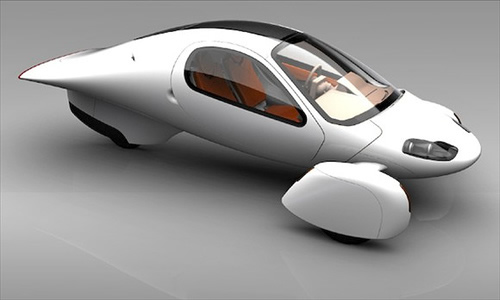
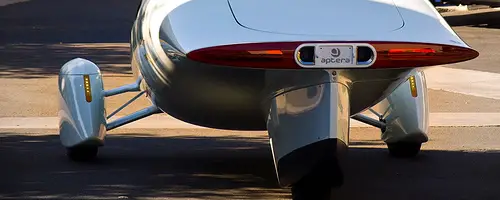
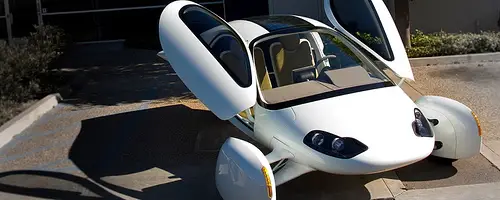
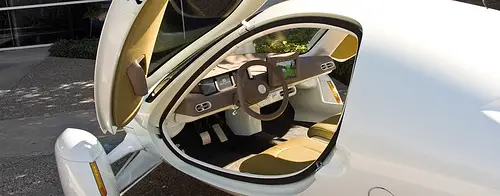
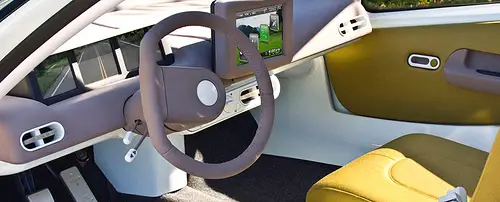
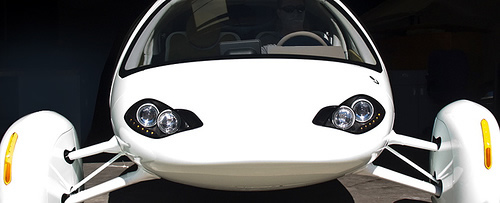
The Aptera Typ-1 Concept Car is a three-wheeled vehicle. The two front wheels are used for steering and the rear wheel is connected to an electric motor. The Typ-1 will consume 60-80 Watt·hours/km at 55 mph (90 km/h), making it a low energy vehicle.

The Typ-1 has a drag coefficient of 0.11, compared with 0.19 for the record-holding EV1.

It has recessed windshield wipers, low rolling resistance tires, and cameras in place of side mirrors. And, did we say it goes 300 miles on a gallon of gas?


Tuesday, April 28, 2009

Concept Car : MDI Air-Powered AirPod


The folks from MDI are holding firm to their ideas for an air-powered car—using electricity to compress huge amounts of air in small tanks, and then slowly releasing that air to drive pistons. The latest iteration from MDI is the AirPod, which seats three passengers, one facing backward. The AirPod uses a pair of wheels mounted side by side in the front to turn the vehicle—operated by the driver with a joystick—while the rear wheels provide power to the ground. The Airpod delivers about six horsepower of performance.

Concept Car : Hinterland Aeronautic EcoVan


At highway speeds, drag resistance can account for 75 percent of fuel consumption. Therefore, designers in Canada put better aerodynamics on the top of their list in the design of a long-range electric vehicle. They aimed for a drag coefficient of less than 0.25, which would beat out the Toyota Prius and the original Honda Insight. Designers want to see the design—something like an aeronautical fuselage on wheels—turned into the ultimate eco-friendly six-seater carpooling machine.

Concept Car : Eco Transportation Phoenix


Future transportation concepts give the world hopes to deliver eco-friendly vehicles that will be far better both in technology and looks. However, all this exists conceptually and we are still not near any such technology that could provide high-speed sporty vehicles with zero emission electric engines. Phoenix is another such conceptual design for American urban life. This machine is in itself a try to blend freedom, strength, and flexibility, with a special concern to our gradually deteriorating environment. Design seems to be inspired from American muscle cars and pick-up trucks. This two-seater car derives power from Flexi-Fuel V8 engine. Not only engine but the bio-composite material and recycled aluminum used in body are other important aspects that make it soft toward the environment.


The tough and agile design incorporates a safety cell made from reinforced bio-polymers with roll-bars behind each seat to provide additional protection. An Orbital Omni-directional four-wheel-drive system makes it capable of rotating around its own axis and sideways. All this sounds fantastic and do go with its name that is inspired by an ancient mythical bird, except that it can’t fly.

Thursday, April 23, 2009

Concept Car : Audi ASQ


Audi ASQ is a futuristic concept for the year 2040. The design considers the worst case scenario effect of global warming; a time when sea levels have risen dramatically. Designed by Juyoung Kim, the ASQ concept moves over land as a normal vehicle, getting power from an electric motor in each of its spherical wheels, once the concept reaches water, it’s a different story altogether.
To maneuver on water, it switches to an aquatic system and uses water jets for propulsion. When in submersible mode, the concept uses a water turbine for motion. It seats three to provide ample space for the passengers and the driver.


Concept Car : MOY


The contest winner, MOY concept car was designed by Elvis Tomljenovic received first price in contest held during auto(r) automotive design conference in Zagreb, Croatia. Elvis Tomljenovic is student of the Zagreb School of Design. Elvis Tomljenovic is finishing student of the Zagreb School of Design. He is currently looking for sponsors/scholarships to continue education in field of automotive design at postgraduate level.


MOY concept is made for generation who uses technology as a means to express themselves and communicate with others. The idea behind MOY concept is that everyone can design their own car on their own computer and then apply the design to the vehicle using wireless data transfer or share it with other people through web-site, forum, e-mail etc. To those who lack the necessary skills or time to create their own design, we offer the option of downloading ready made designs. The vehicles are interconnected, so the change is possible in motion. Movement recognition technology enables us to draw on the car in real time.


Since MOY can display both static images and videos, it can be used as a new medium of promotion. Vehicle is powered by batteries that charge electro motors set in wheels and controlled by drive-by-wire technology. The body of the car is made of outer and inner polycarbonate layers, with layers of liquid crystals, LED diodes and electro chromic foil (film) in between.


auto(r) is the biggest automotive design conference in Europe in 2009 and the first ever held in South East Europe (SEE). The conference theme: “Professional automotive designers from SEE”, born or originated. This is the first time ever that this subject has been taken to the public. A title auto(r) has been chosen because it combines two words - automobile and author. Our mission is to present designers as authors of automobile designs.


Tuesday, April 21, 2009

Concept Car : One-seater urban city vehicle


Basically this vehicle employs an electric hub-less wheel configuration on 2+1 wheel drive-train.
For the rear, there is a mono wide wheel, which is a drum type. It is for better power support and stable stance for the sport performance. he vehicle is constructed from 3 parts, which are the front axle, folding middle shaft and rear axle.
The front and rear axle have commonly a fuel cell electric engine on the each wheel. And it is combined with the electric disk brake system. These devices make no knocking-noise and zero emission to make the environment clean.

Concept Car : Galapagos

GALapagos project by Igor Yastrebov shows the evolution of Vehicle for the future. It can be adopted to any road situation, that can happens in the MEGALOPOLES with transformable wheel base. GALapagos can be Motor bike with narrow weel base or can be a real comfortable car for two passengers.


Sunday, April 19, 2009

Concept Car : 2028 Volkswagen Room


Let’s see what we can look forward to in the year 2028. Britney’s kids will be readmitted to rehab for the 14th time after getting caught being average and functional. The US is bought by two Chinese business men as a place to keep all their stuff and my girlfriend will still think she looks fat in her 9,763rd pair of jeans. Oh and Volkwagen will be releasing some pretty “safe, comfortable and efficient..” vehicles. Sure, these cars still won’t fly, but they will interact with traffic lights, park automatically and change color with the press of a button. Volkswagen presented this concept exercise into what the future of automobiles may look like in 2028…cast your eyes into their crystal ball and tell us what you think.

The Volkswagen Ego is a sporty two-seater. Our definition of driving fun: a car that doesn’t just fit in with the driver and traffic conditions, but also considers the needs of the environment. It will have multitude of sensors that will permanently scan the vehicle surroundings. In addition to radar sensors, there will also be cameras, laser and ultrasound sensors that supply a specific image of the vehicle surroundings.
The Volkswagen One is the ideal car for people with an active, urban lifestyle. With its flexible chassis design, it fits into every parking space and joins together with other ones to form trains during rush hour that can be steered automatically past every traffic jam.
The Volkswagen Room is a car for the whole family. Contains assistants and a manager to support you. Driving assitance systems, intelligent traffic management systems and expanded navigation software can take over driving for you in a certain situations. For example when you’re on the motorway, the car positions itself automatically in the traffic, plans lane and speed changes jointly with other road users and brakes until stationary in emergencies.
Take a look for yourself, and let your voice be heard at www.volkswagen2028.com
Related Posts Plugin for WordPress, Blogger...