Showing posts with label concept. Show all posts

Saturday, August 21, 2010

ecocar car : Electric Car Uses Bumps to Charge Battery

This strange looking car is an interesting concept designers, industrial Kim Jung Hoon was a record year for the 2010 Michelin Challenge Design competition. Unlike other electric cars, which is connected in particular in relation to the charging station or an extension cord, Eco-P has four piezoelectric devices to recharge the battery when the car is moving.


Kim thought the P-Eco, that the car is a lot of energy that can be collected and converted to lose. Whenever the vehicle is in motion, and vibration is reflective and could be used piezoelectric device to generate power that can recharge the battery. Piezo on both sides of each seat, this concept car can not be operated effectively without additional costs for electricity or gasoline.


Car, of course, the need for other energy sources, such as backup, especially if it is not used for some time. But it would be fairly easy to draw, and the batteries to charge only in the home network, and then keep moving car while on the road. Concept is based on the future effectiveness of the piezoelectric based, it makes sense, I know, but now will one day produce uneven road, it was really good.

Tuesday, March 3, 2009

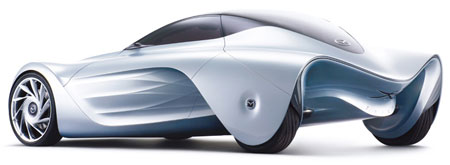
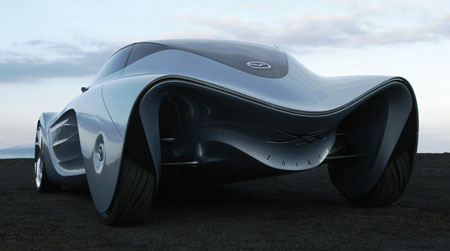
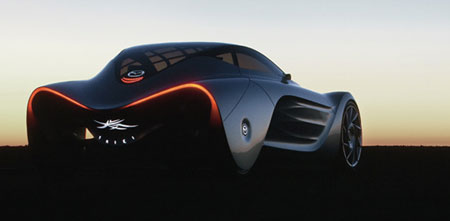
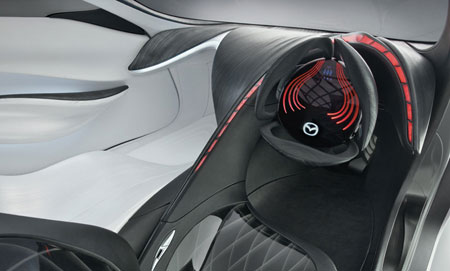
Mazda Taiki Concept


Mazda’s latest series of concept cars seem like odd organic cars that do not look like it may make it’s way into production form anytime soon, and the latest is the Mazda Taiki concept which continues to follow the Nagare theme established with the first car in the new concept line, the Mazda Nagare. Nagare means flow, and Mazda turned to nature for inspiration - using cues from natural flow lines all around us - shapes in sand dunes etched by the wind, ocean waves, lava flow down a volcano, and etc.
All three design centers - US, European and Japan contributed to this series of concepts, with cars like the original Nagare coming from the US-based design center and the Mazda Ryuga from the Hiroshima Design Center in Japan. The Mazda Hakaze design concept came from the European Design Center.
The Mazda Taiki is the fourth in the series, and this one comes from the Hiroshima Design Center team led by Chief Designer Yamada Atsuhiko. Every concept car represents a different segment of future cars, for example the Mazda Ryuga was envisioned as a future compact car. The Mazda Taiki points to a possible future design direction for Mazda sports cars.
The stretched coupe has short overhangs and its interior has a liberating and free feel to it thanks to an all-glass canope. It has a drag coefficient of 0.25 and zero lift. Air is channeled through the front fender via a tunnel formed between the body and the rear fender - this creates downforce.
This design concept is also used to unveil some technical goodies. The 2-seater Mazda Taiki is conceptually powered by the next generation RENESIS rotary engine engine called the RENESIS 16X. The engine will be mounted at the front and will power the rear wheels, a proven formula for a sports car.
More details on that engine will come in a later post, but you’ll be pleased to know that Mazda is the latest manufacturer to jump on the twin clutch bandwagon. The RENESIS 16X engine will be mated to a 7-speed dry twin clutch transmission. Suspension is a double wishbone setup for both front and rear, and the car rides on 22 inch Enkei wheels wrapped with Yokohama Advan Super-E spec Prototype 007 tyres in 195/40R22 size. As for dimensions, the Mazda Taiki is 4620mm long, 1950mm wide, 1240mm tall and has a wheelbase of 3000mm.


paultan.org

Saturday, February 28, 2009

Scion Concept Takes xB Off-Road, Off The Map


Designed and painted by artist David Choe, this unique “Monster Truck xB

Monday, February 23, 2009

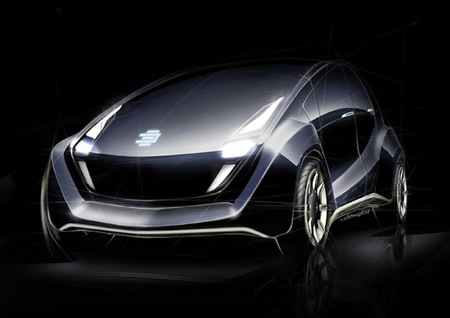
"OLED-clad car " German engineers

'Leccy Tech With the Geneva Motor Show on the horizon, German engineering services provider EDAG has released a preview of what it hopes will be one of the stars of the 2009 Swiss auto gathering: the “Light Car – Open Source”, a concept it is describing as “visionary and courageous”.

The LC-OS consists of a rolling chassis that can be adapted to a number of styles and roles by using different body panels. Drive will be provided by four in-wheel electric motors powered by a lithium-ion battery pack which give the vehicle a range or around 150km (90-odd miles).


far so good, but now things start to get a bit sci-fi.

To begin with, the LC-OS's body panels will be made from something called basalt-fibre made by Austrian company ASA.TEC.

Rather being made of chunks of the Giant's Causeway, basalt fibre is made up of the minerals plagioclase, pyroxene, and olivine – none of which we had actually heard of before today - and while similar in usage to carbon fibre and fibreglass, it's tougher than the latter and cheaper than the former. It is also fully recyclable and has a specific tenacity three times that of steel. At least that's what is says here.

The basalt-fibre body panels will apparently be transparent giving the car the appearance of being made of glass - so bad news for anyone who likes to drive while nude – although EDAG's announcement is a little contradictory on this point.

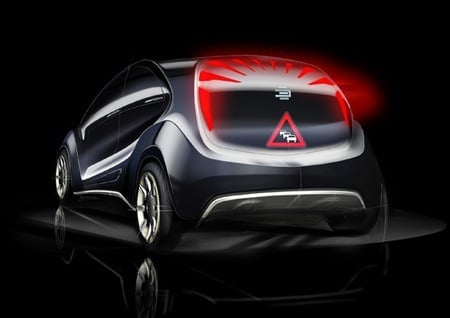
Some or all of the outer and inner bodywork will be used as a giant OLED screen which can portray lights and instruments as, when and where the driver wants, in effect turning the entire car into a computer desktop - well, sort of.

"We have transferred today's multimedia and lighting technology standards to the car, and in future want to offer the customer scope for free configuration, as the entire surface of the vehicle functions like the display of a multimedia installation, and can be used intelligently and individually,” said Johannes Barckmann, head of the EDAG Design Studio.


Uses for this include a graduated display of the LC-OS' braking force on a whole tailgate screen “brake light”, which could be helpful for those driving behind an LC-OS once they have got over the shock - or for posting rude messages to other motorists.
Before you ask, we should point out that the company's use of the term 'open source' isn't quite how we all understand it. This is no come one, come all collaborative design project - EDAG's simply approaching other firms to help it work on the tech.
The LC-OS will be 4m long, 1.7m wide, and thanks those neat in-wheel motors will have a 2.9m wheel base giving ample space for five passengers.
Come the opening of the Geneva show on 5 March, we will have more of an idea as to how much of EDAG's plans are based on hard engineering and how much on their design department smokin' and a-tokin' late one night

Tuesday, February 17, 2009

Toyota Hi-Ct concept car


Have you ever seen that Element that some people have been driving? I always thought those rectangular cars were odd, like giant shoeboxes. It appears that Toyota has rolled out an environmentally friendly box-shaped car.

The Toyota Hi-Ct concept car was first shown at the Bangkok International Motor Show, but not at the more famous New York Auto Show. This hybrid vehicle can charge from an external electric source, such as a AC100V accessory socket.
Related Posts Plugin for WordPress, Blogger...